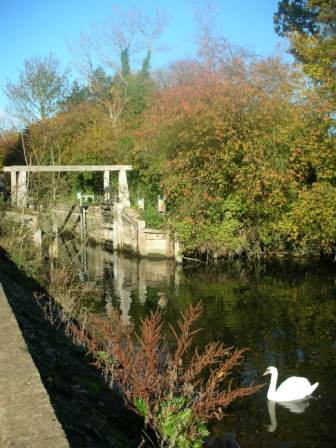
 There were originally thirteen locks and thirteen staunches (also known as flash locks) along the river and these were entirely constructed form timber. A distinguishing feature of the locks was the lintel that prevented the locks from collapsing inwards. This was almost unique to the Stour and has therefore been used in the River Stour Trust logo as well as being the name of our bi-annual journal, the Lock Lintel.
The early designs of staunches or flash locks had a single gate that upon opening would release a sudden surge of water. Boats moving downstream would wait above the lock until the gate was opened and a ‘flash’ of water carried the boats with it. Later designs comprised two sets of lock gates and a central chamber. Craft enter the chamber and water is released either from or into the central chamber. This brings craft to the same level as the water beyond the second pair of gates to continue passage along the river.
The River Stour Trust seeks to reinstate the locks along the river to enable through navigation. Over the years, we have succesfully restored four of the thirteen locks at Dedham, Flatford, Great Cornard and Stratford St Mary.
Use of these locks is subject to RST Facilities: Code of Practice
CURRENT MAJOR PROJECT – Essential repairs to Dedham Lock (see below).
DEDHAM LOCK
In 1990 the Environment Agency decided to utilise both Dedham and Flatford Locks for flood control purposes and a tilting weir was inserted into the floor of each lock. At the same time, the River Stour Trust carried out improvement works to the lock gates that enabled the lock to be re-opened for navigational use. The unique paddle gear and gates are replicas of the original design.
Unfortunately, the lock is currently unusable due to the gates needing to be replaced once again.
At one stage of the negotiations, we had to take expensive advice from a riparian barrister, experienced in waterway issues, to prove that the right of navigation still existed, even though the lock has been out of use for some years.
This will be a major project, and will require closing off the ends of the lock, pumping out the water, removing the old gates, and fitting the new ones. We are delighted to have had terms of the lease finalised and accepted by all concerned parties. So far, we have obtained funding of £85,000 but delays beyond our control (particularly Covid-19) have meant that the project costs have risen significantly. When applying for grants, we have stressed not just the heritage aspect of the river, but its role as a vital community asset, made so much more important since lockdowns.
We welcome any contributions towards this vital project – click here to donate.
Read a brief history of Dedham Lock – click here.
FLATFORD LOCK
The River Stour Trust restored Flatford Lock which involved removing tons of mud and silt from the chamber and making the gates watertight. It was opened on Easter Day in 1975 by Lord Greenwood of Rossendale who was a President of the Trust at that time. In 1990, the Environment Agency decided to utilise both Flatford and Dedham Locks for flood control purposes and a tilting weir was inserted into the floor of each lock. By this time, the lock gates were in a poor condition once again and a national appeal successfully attracted sponsorship for the works and new lock gates were installed in 1991. Lintels were also added to maintain a traditional appearance. It was officially re-opened in 1992 by John Constable, a descendant of the well-known painter and a President of the Trust at that time.
In 2014, the wooden lock gates had rotted and the chosen replacement material was a hard wood from South America called Ekke. Our chosen contractor for this project was Martin Childs Ltd. The Trust were pleased to obtain funding toward the project from Veolia, Essex Environmental Trust and the Environment Agency. The lock was formally re-opened on Saturday 2 May 2014 by River Stour Trust vice-president, Griff Rhys Jones.
 GREAT CORNARD LOCK
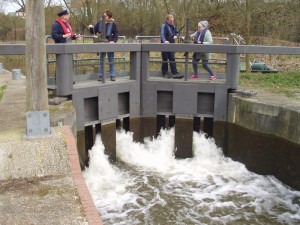
The lock had become derelict in the 1920s and an automatic weir was built on its site. The River Stour Trust was responsible for the construction of a new lock adjacent to the site of the original lock. The new lock has a chamber constructed from concrete and brick whilst the gates are steel.
The addition of the wooden lintels was not structurally necessary but retained the traditional and unique design element of the original lock. The lock was formally opened in September 1997 and restored passage between Sudbury in Suffolk and Great Henny in Essex. It was the first new lock on the river for over 200 years and the first completed Millennium project in East Anglia.
The principle of the lock operation for Great Cornard is identical to that of locks on other waterways and the mechanism is similar to those on British waterways canals. A particular feature is the inclusion of a locking device, opened by a key, which prevents unauthorised use of the lock. Lock operators should be in possession of a British Waterways (BW) padlock key (for the anti-vandal padlocks on the gate paddles) and windlass to operate the paddles. BW keys can be purchased online – click here.
ROGER BROWN LOCK (AKA STRATFORD ST MARY LOCK)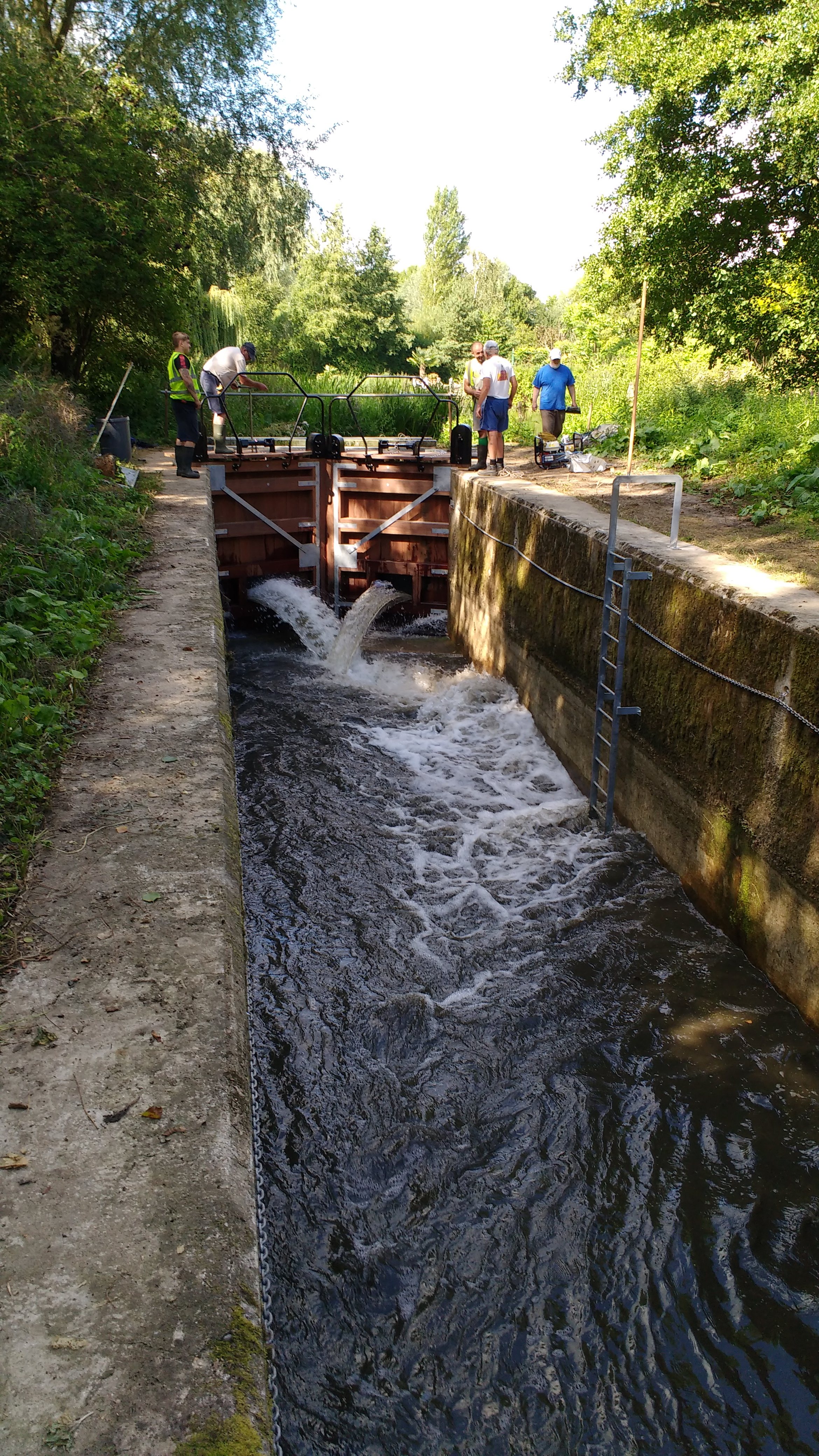
The restoration of this lock follows the successful restoration of the locks at Flatford, Dedham and Great Cornard; and opens a further three miles of navigation along the River Stour. In Victorian times, and until the late 1950s, a boat hire station existed in the lock cut demonstrating that the river has been used recreationally for many years.
We are delighted that the lock is now operational and is renamed the Roger Brown Lock in honour of one of our dedicated volunteers who maintained their enthusiasm and determination to complete this project for over 12 years!
Our chosen contractor for this project was Hargreaves Foundry Ltd. The Trust were pleased to obtain funding toward the project from Enovert (formerly Cory Environmental Trust in Britain), Inland Waterways Association Tony Harrison Legacy Fund and fundraising by the River Stour Trust. The lock will be formally re-opened on Saturday 12 May 2018, the Trust’s 50th Anniversary Year, by River Stour Trust vice-president, Griff Rhys Jones, together with Mark Harling, Regional Manager of Enovert, the main sponsors of the project.
Passage for licensed craft is possible by prior notice, but the frequency of use of the lock is severely limited by the terms of a water extraction licence issued by the Environment Agency (licence number AN/036/0018/005).
If you wish to book a passage please contact either our Honorary lock-keeper (0844 800 5018) or the River Stour Trust office (01787 313199) during normal office hours. Please note: The 0844 number is connected to personal home telephones of a River Stour Trust volunteer. 0844/45 numbers cost 7p per minute plus your phone company’s access charge. Example: BT standard call charge 23p pence per minute. Mobile charges can be considerably more.